
 Русский
 Deutsch
 Español
 Français
 Українська
Solving a Nonogram, Explained with a Heart Example
Nonograms, or picross as some people call them, are much easier to explain with a real grid than with words, so let's use one.
Start with the biggest numbers
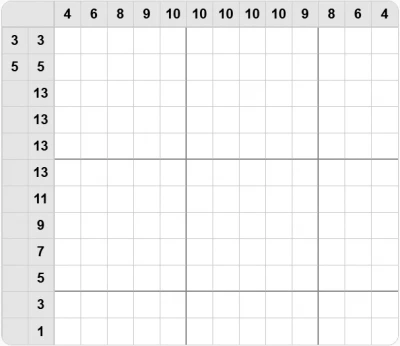
This is an empty field, 13 cells wide and 12 tall. The numbers on the left belong to the rows, the numbers on top belong to the columns, and each number tells you how many cells in a row must be filled.
It's best to start with the biggest numbers. Here we have four rows marked 13, and since the field is exactly 13 cells wide, those rows are filled in completely.
When a line has two numbers, like 3 3, there has to be at least one empty cell between the groups, and that's the part people forget most often.
Add crosses
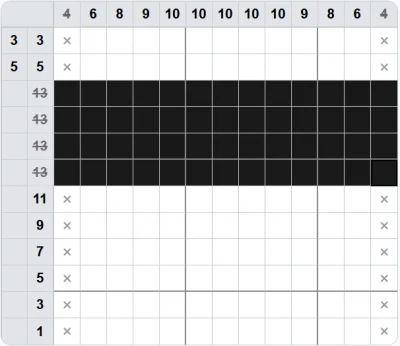
Now there are four black stripes in the middle. Look at the outer columns with the number 4: each of them already has exactly four filled cells, so everything else in those columns is empty, and we mark it with crosses.
A cross doesn't paint anything, it's just a note to yourself that black can't go there. It also helps to strike out the numbers you're done with, so you always see what's left.
Finish rows 5 5 and 11
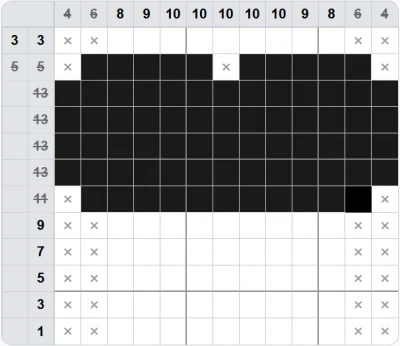
Two more rows appear on the third screenshot. The row 5 5 has crosses on both sides, and the two fives plus the gap between them take up all 11 remaining cells, which leaves a single empty cell in the middle.
The row with 11 is squeezed in the same way, so it gets filled completely. The columns with the number 6 are finished now too, and you can put crosses in them.
Work your way down
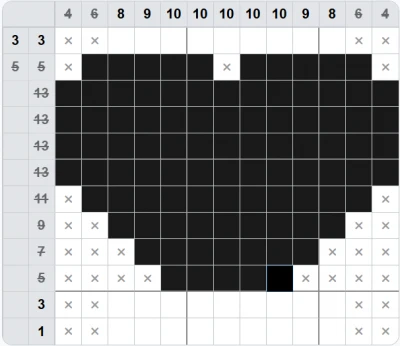
The lower part goes fast. Crosses from the columns with 4 and 6 reach the very bottom, and in the row 9 exactly nine cells are left between them, so we fill them.
Once the column with 8 is finished, new crosses show up, and the row 7 falls into place the same way, followed by the row 5. The shape narrows toward the bottom, and you can already tell it's going to be a heart.
Complete the heart
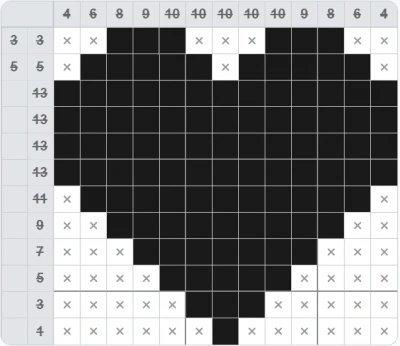
Only the top row 3 3 and the two bottom rows, 3 and 1, are left, and the columns tell you where they go.
If every number is struck out and you got a heart, you solved it correctly.
Once you can do this without hints, try making a puzzle of your own: with our nonogram generator you draw a picture, choose the size of the field, and other players can try to solve it.