Diagonal sudoku is solved just like the regular kind, it simply has two more groups. If you haven't tried classic sudoku yet, have a look at our guide first, everything there applies here too.
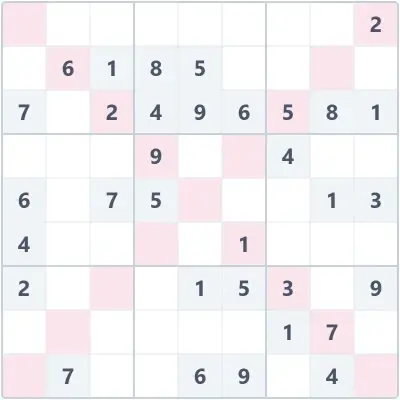
The two main diagonals, running corner to corner, count as two extra groups, just like a row or a column. Each of them must also contain the numbers 1 to 9 exactly once. On the grid they're highlighted in pink.
Everything else stays the same: no repeats in a row, a column or a 3×3 box.
2
Check the diagonals first
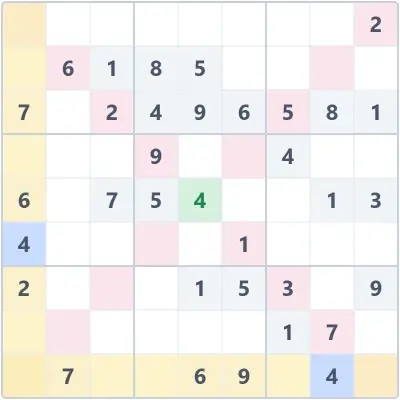
The main diagonal, from the top-left corner to the bottom-right, already has six numbers. It's missing 4, 5 and 8, and there are three free cells: two corners and the centre.
The 4 can't go in the top-left corner, because the first column already has a 4. Not in the bottom-right one either, the ninth row has a 4. That leaves the centre, so the 4 goes there.
A diagonal is harder to notice than a row, which is why people skip it. Scan both diagonals the same way you scan rows.
3
The centre and the corners
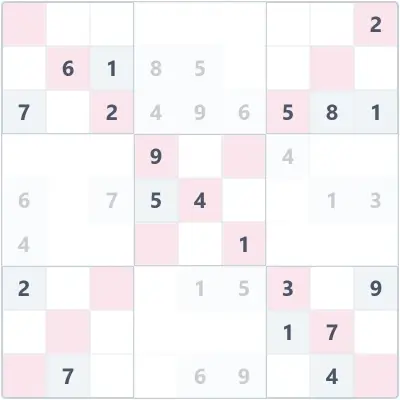
The centre cell sits on both diagonals at once, and it also has its row, column and box. That's five groups for one cell, so it usually has the fewest options. In our example, that's exactly where the answer turned up.
The diagonals cross five of the nine cells in the centre box and three cells in each corner box. The side boxes have no diagonal cells at all, so look for the extra clues in the middle and in the corners.
In the picture the side boxes are faded so you can see where the diagonals run.
4
Find a number on the diagonal
Check a diagonal the same way as a row: take a number it doesn't have yet and look for where it can go.
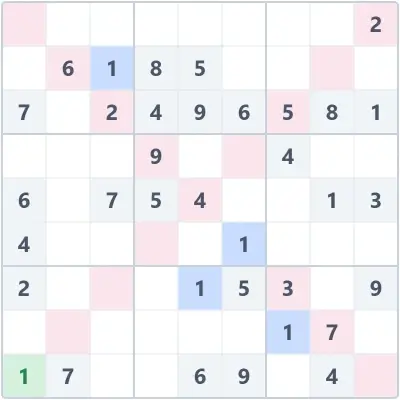
The picture shows the anti-diagonal, from the top-right corner to the bottom-left. It has no 1 yet. We already filled the centre with a 4, and every other empty cell but one is ruled out: its row or column already has a 1, and those 1s are highlighted. Only the bottom-left corner is left, so the 1 goes there.
The most common mistake: a number fits the row and column, but it's already on the diagonal.
You'll find diagonal puzzles in the main sudoku list alongside the others. Fancy another extra rule? Try odd-even sudoku.
All sudoku

 Русский
 Deutsch
 Español
 Français
 Українська