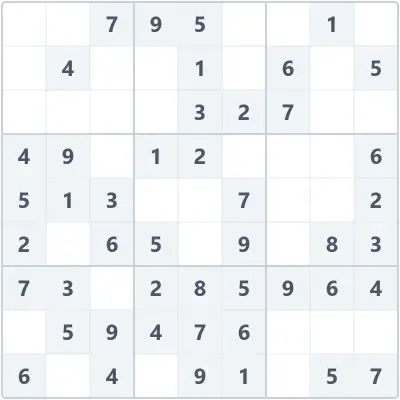
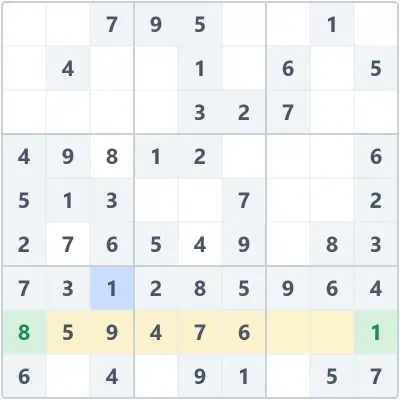
Let's go through the rules and the main techniques on a real easy sudoku from our site. It sounds harder than it is: on this grid the first numbers turn up almost straight away.
The 9×9 grid is split into nine 3×3 boxes, separated by thick lines. Every empty cell gets a number from 1 to 9, and that number can't repeat in its row, its column or its box.
So each row, column and box ends up with all nine numbers exactly once.
There's no guessing involved: a well-made sudoku has a single solution, and you can always reach it by logic.
2
Start with nearly full rows
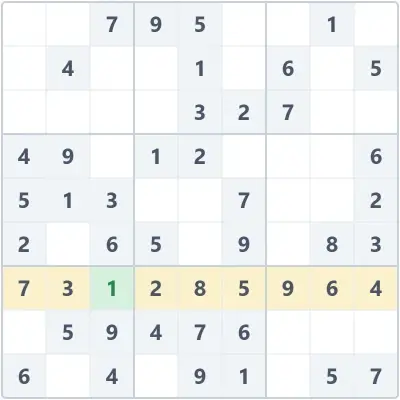
Look at the seventh row: it already has eight numbers out of nine, only the 1 is missing. There's one free cell, the third from the left, so the 1 goes there.
Rows, columns and boxes with just one or two gaps are worth finding first, they solve themselves almost without thinking.
Before writing a number, check it against the column and the box. Here there's no 1 in the third column or in the bottom-left box, so it fits.
3
Find a home for one number
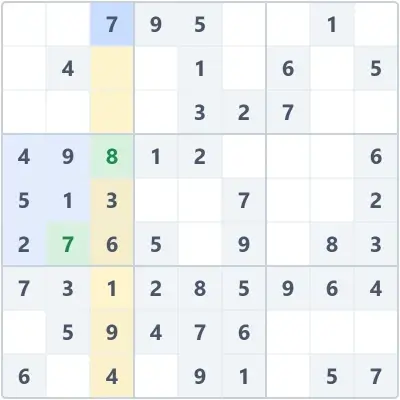
Now the middle-left box. It's missing two numbers, 7 and 8, and has two free cells: top right and bottom middle.
Take the 7. The third column already has a 7 at the very top of the grid, so it can't go into the top-right cell of the box. That leaves the bottom-middle cell for the 7, and the remaining cell gets the 8.
It helps to draw imaginary lines along the row and column of every number. Wherever a line passes, that number can't go. This is called cross-hatching.
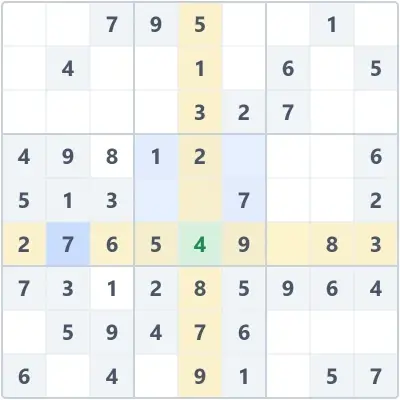
The second method works the other way round. Instead of a number, you take a cell and check what could possibly go in it. Pick cells whose row, column and box are already fairly full.
Take the empty cell in the middle of the sixth row. The row rules out 2, 3, 5, 6, 7, 8 and 9, and we placed that 7 ourselves in the previous step. The column adds 1. Out of nine numbers only 4 is left, so that's the answer.
5
Pencil marks and checking
On medium and hard puzzles these methods stop finding new numbers at some point. That's when you write small candidates in the empty cells, every number that could still fit.
Pencil marks show where a cell has few options. In the picture, the eighth row is missing 1, 2, 3 and 8, and its first cell can only take 1 or 8. We already put a 1 in that box in step 2, so this cell is 8. Now the column leaves only 1 for the last cell of the row.
If a number does repeat, the game highlights the conflicting digits. The mistake may have happened earlier, so don't just fix the last one.
Update your marks after every number and never place one at random: a guess usually ends with erasing half the grid.

 Русский
 Deutsch
 Español
 Français
 Українська