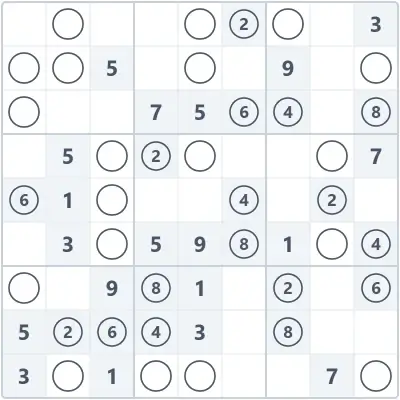
This variant differs from regular sudoku only by the circles in the cells. They cut down guesswork a lot: each cell can take four or five numbers instead of nine.
The classic rules stay: 1 to 9 with no repeats in a row, a column or a 3×3 box.
Cells with a circle are even and can only hold 2, 4, 6 or 8. Cells without a circle are odd and take 1, 3, 5, 7 or 9.
2
Four circles in every row
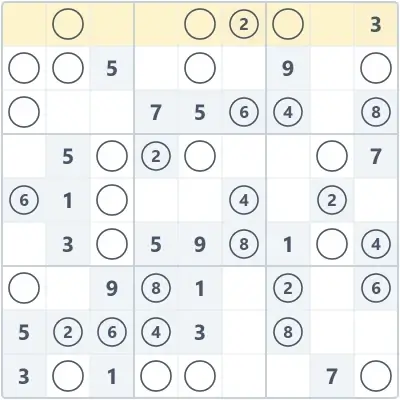
There are four even numbers from 1 to 9 and five odd ones. That's why every row, column and box has exactly four circled cells and five plain ones.
The picture highlights the first row: four circles and five plain cells.
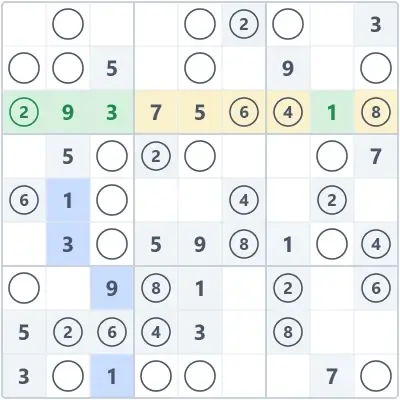
Once three even numbers of a row are in place, the fourth finds itself: it's the missing even number, and it goes into the last free circle.
The third row has four circles, and three of them already hold 6, 4 and 8. The 2 is missing, and there's only one free circle, on the far left. So the 2 goes there.
That leaves three cells without circles, and they need the odd numbers 1, 3 and 9. The second column already has 1 and 3, so it gets 9. The third column has 9 and 1, so it gets 3. The last cell gets 1.
4
Pencil marks and the usual mistake
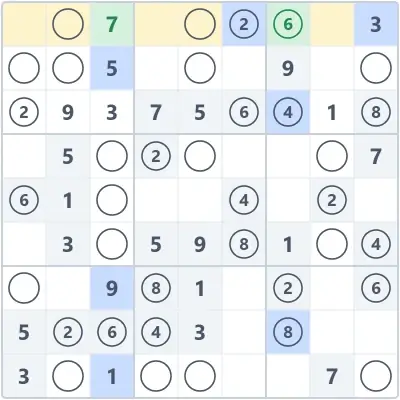
A circled cell has at most four candidates, a plain one at most five, and after crossing out by row and column there are usually two or three left. So pencil marks go much faster here than in classic sudoku.
The picture shows the first row. The third cell has no circle, so it needs an odd number: the row already has a 3 and the column has 1, 5 and 9, which leaves only 7. The seventh cell has a circle: the row already has a 2 and the column has 4 and 8, which leaves only 6.
The usual slip is writing a number that fits the row and column but not the circle. Everything else works as in regular sudoku.
Before placing a number, check whether the cell has a circle.

 Русский
 Deutsch
 Español
 Français
 Українська