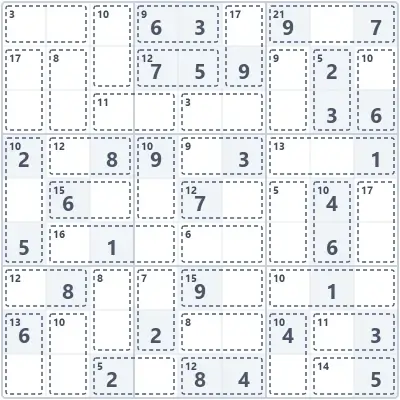
In killer sudoku, besides the starting numbers, the grid is split into cages outlined with dotted lines, each with a small number in the corner. That number is the sum of the digits inside. It looks intimidating, but half the work here is plain arithmetic.
All the classic sudoku rules still apply: the numbers 1 to 9 can't repeat in a row, a column or a 3×3 box. The number in the corner of a cage is the sum of the digits inside it.
Digits can't repeat inside a cage either, even when the cage spreads over two boxes.
Two cells adding up to 4 can't be 2 and 2, only 1 and 3.
2
Sums with only one combination
Some sums can only be made with one set of digits. Keep this table handy for your first few puzzles:
| Cells |
Sum |
Digits |
| 2 |
3 |
1, 2 |
| 2 |
4 |
1, 3 |
| 2 |
16 |
7, 9 |
| 2 |
17 |
8, 9 |
| 3 |
6 |
1, 2, 3 |
| 3 |
7 |
1, 2, 4 |
| 3 |
23 |
6, 8, 9 |
| 3 |
24 |
7, 8, 9 |
| 4 |
10 |
1, 2, 3, 4 |
| 4 |
30 |
6, 7, 8, 9 |
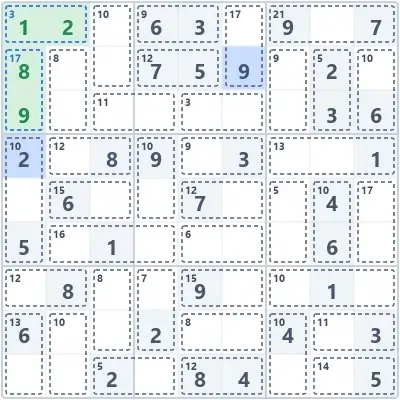
Here's an example. The 3 cage can only hold 1 and 2. The first column already has a 2, so the 1 goes on the left and the 2 on the right. The 17 cage can only hold 8 and 9, and the second row already has a 9, so the 8 goes on top and the 9 below.
The sum alone doesn't tell you which digit goes where, but you know the set straight away, and the row or column often settles the order. These cages are the best place to start.
The numbers 1 to 9 add up to 45. So every row, every column and every box also adds up to 45.
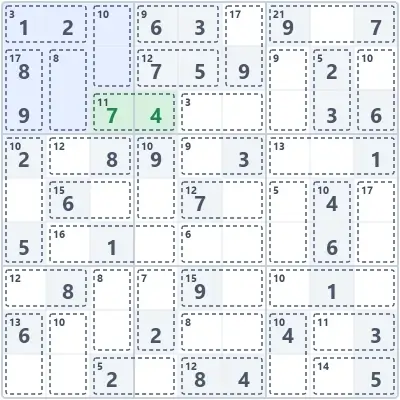
In the picture, four cages lie entirely inside the box: 3, 17, 10 and 8, which makes 38. Only the bottom-right cell isn't covered, because its cage runs into the next box. 45 minus 38 is 7, and that's the answer. And since the 11 cage has only two cells, the other one must be 4.
The same counting works for rows, columns and even several boxes in a row, you just count from 90 or 135.
4
Then carry on as in regular sudoku
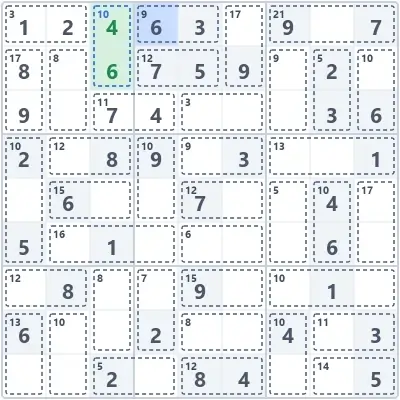
When a cage has two cells and you know their sum, there aren't many options. In the picture, the 10 cage sits in the top-left box. That box already has 1, 2, 7, 8 and 9, which we found in the previous steps. Of the pairs that make 10 (1 and 9, 2 and 8, 3 and 7, 4 and 6), only 4 and 6 fit. The first row already has a 6, so the 4 goes on top and the 6 below.
Cross-hatching and candidate pairs work just like in classic sudoku, they just kick in a bit later, once there are more numbers on the grid.

 Русский
 Deutsch
 Español
 Français
 Українська